

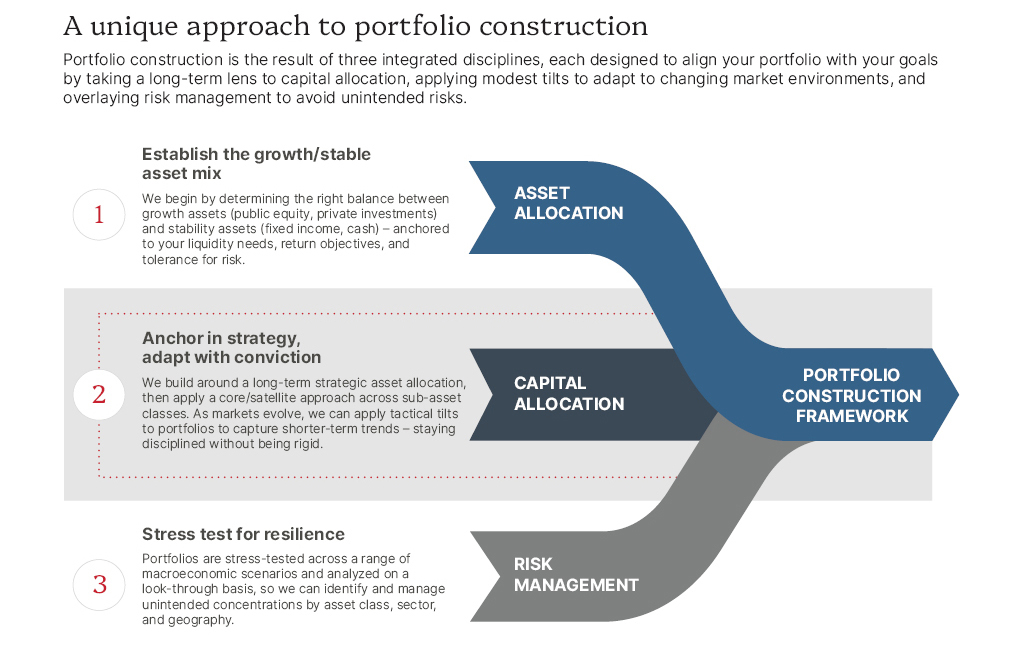
Graphic depicting BBH’s three-pronged approach to portfolio construction: asset allocation, capital allocation, and risk management.
At BBH, our clients’ success is at the center of everything we do. We go the extra mile to help them achieve their goals and objectives, preserving and growing wealth along the way.
To do so, we must question and test common investment industry assumptions, with the idea that a rigorous application of “truth seeking” will position us to generate better results for our clients. We have crafted sophisticated frameworks in our unique approach to portfolio construction to enhance the traditional asset allocation process.
Our holistic approach to portfolio construction
We believe in a multipronged implementation of several different allocation frameworks that seek to achieve a balanced, resilient portfolio. The Investment Research Group (IRG) has frequently discussed our unique three-step approach to portfolio construction, which involves asset allocation, capital allocation, and risk management. Importantly, each of these elements incorporates additional second-order allocation frameworks, such as:
- Risk-return goals
- Objectives
- Liquidity needs
- Role in the portfolio
- Equity building blocks
In this article, we describe how we use each of these allocation frameworks to construct custom portfolios that meet each client’s risk/return objectives, as well as goals and liquidity needs. The following chart depicts how these frameworks inform our portfolio construction process.
Strategic asset allocation
Most in the investment industry think of asset allocation as using techniques such as mean-variance optimization (MVO) to bucket portfolios among different sub-asset classes based on top-down macroeconomic and financial market variables.
However, we define asset allocation as the process of selecting the optimal mix of cash, fixed income, public equities, independent return, and private investments that best balances a client’s goals, objectives, liquidity needs, and risk tolerance. This is what we call strategic asset allocation, which is the main driver of client outcomes.
… [W]e define asset allocation as the process of selecting the optimal mix of cash, fixed income, public equities, independent return, and private investments that best balances a client’s goals, objectives, liquidity needs, and risk tolerance.”
Determining a client’s investment goals is a critical step in the portfolio construction process. Considerations we assess for each client include:
| Client investment portfolio | |||
| Financial situation | Risk tolerance | Preferences and constraints | Investment goals |
|
|
|
|
These considerations can further be refined to several second-order allocation frameworks:
- Risk-return goals
- Objectives
- Liquidity needs
Risk-return goals-based allocation
Risk-return goals-based allocation is often used in conversations involving one’s investment policy statement (IPS). We manage investment portfolios that span the spectrum of risk tolerance and return objectives.
For a client seeking to support both current and future spending needs by focusing on income, liquidity, and total return, we would establish a strategic asset allocation to mostly stable assets that generate income, such as fixed income and cash, and less to growth assets, such as public equity, private investments, and independent return.
On the other side of the spectrum, for a client seeking to preserve and grow purchasing power by employing an approach focused predominately on capital appreciation, we would establish a strategic asset allocation largely comprising growth assets, such as public equity, private investments, and independent return, and less to stable assets that generate income.
A risk-return goals-based allocation facilitates conversations around potential trade-offs between expected returns and several different definitions of risk. We often share charts like the one below to engage our clients in “what-if” scenarios, which helps us better align their portfolios with their true return objectives and risk tolerance.

Chart depicting allocation across core and satellite portfolios, with the Y-axis being long-term outperformance (0% to 10%) and the X-axis investment duration (zero to 10-plus years).
An asset allocation comprising 95% equity and 5% fixed income (solely using index performance) has experienced annual returns that range from 52% to -47%. Clients who are unwilling to potentially incur such volatility should consider portfolios with lower equity exposure.
It is worth noting that in order to complement traditional equity and fixed income, we invest in private market investments and independent return strategies to enhance overall performance, increase diversification, and reduce portfolio risk.
We do look to analyses such as MVO to help inform risk-return allocation, but we emphasize that it is just one of many different considerations that should inform one’s overall portfolio construction.
Objectives allocation
Objectives-based allocation can also help refine a client’s portfolio, with separate return and risk goals for each objective. Objectives can include:
- Spending
- Philanthropy
- Retirement
- Opportunistic capital (e.g., cash intended for once-a-decade opportunities)
- Inheritance
Such allocations help increase the probability that a portfolio will meet a client’s goals, as success is often multidimensional and reflects more than one objective.
Liquidity needs allocation
Liquidity refers to the ability to convert an investment to cash without affecting its market price. The determination around a liquidity needs allocation framework is often closely related to a client’s assets and liabilities, age, and time horizon.
For example, a young client with few liquidity needs and a long time horizon could choose to invest a large percentage in relatively illiquid investments, whereas a client with large upcoming liquidity needs would be advised to have a higher allocation to cash and fixed income by comparison.
Our liquidity needs allocation breaks down all of the underlying investments by liquidity classification (for example, highly liquid, liquid, and limited liquidity), which allows us to ensure that our clients’ liquidity needs are met. Stress testing the liquidity of the portfolio can provide enhanced comfort that the desired liquidity will be available in potential times of stress.
It is worth noting that these three components of asset allocation – returns, objectives, and liquidity – should not be viewed in isolation. Rather, it is the combination of them all, and the conversations they foster, that facilitate great portfolio construction.
Capital allocation
Capital allocation, including manager selection, involves identifying exceptional investment managers capitalizing on market inefficiencies.
We take a bottom-up approach to manager selection and then combine with our long-term top-down views to set sub-asset class targets. Our goal is to construct a diversified portfolio that seeks to meet our clients’ return objectives in a risk-adjusted manner. Our sub-asset class weights are largely determined by our long-term conviction in specific investment managers and the risk-adjusted return potential of the sub-asset class.
This blended bottom-up and top-down approach prevents us from forcing capital into a sub-asset class where we cannot find a manager that meets our rigorous standards. All investment opportunities must compete for capital against all other opportunities, including the passive alternative, regardless of sub-asset class. Our allocation approach balances where the best use of active risk is taken, considering passive in more efficient markets (such as U.S. large-cap public equity) to reserve our active risk budget for higher alpha1 potential markets (for example, private investments and independent return).
Our approach to capital allocation, which expands beyond traditional asset classes, seeks to generate additional alpha for our clients. The scale to which the traditional asset class approach is practiced often causes market inefficiencies that position us to find overlooked, yet exceptional, investment managers. For example, many U.S.-based advisors use a U.S./international equity construct that implicitly removes global strategies (that is, strategies that can invest in both the U.S. and internationally) from consideration. A flexible mandate that invests in both the U.S. and internationally seeks to partner with managers who do not fit squarely into commonly used classifications. Accordingly, we have found an attractive universe of such managers who have typically been overlooked as an accident of traditional asset allocation structuring.
Additionally, alpha can take many forms, including tax alpha, which allows us to offer our clients tax-managed equity. Tax-managed equity seeks to replicate benchmark returns but in a more tax-efficient manner (i.e., inclusion of tax-loss harvesting) to outperform on an after-tax basis.
Our inclusion of independent return strategies, which we often refer to as “opportunistic,” does not fit neatly in any traditional asset class. Independent return strategies are diversified across structures (public and private markets), sectors, and securities, often investing in niche, idiosyncratic opportunities where a manager may have a distinct expertise or edge to generate alpha. A flexible mandate for independent return that seeks to generate equity-like returns with low correlation to traditional equity markets allows us to partner with an attractive universe of managers across distressed and special situations, reinsurance, real assets, and more.
We believe that our approach to portfolio construction provides a richer universe of opportunities, resulting in a high-quality portfolio that best optimizes return for a given level of risk.
We believe that our approach to portfolio construction provides a richer universe of opportunities, resulting in a high-quality portfolio that best optimizes return for a given level of risk.”
Our capital allocation process demands that we partner with best-in-class managers who can drive outcomes such that our portfolios meet client goals over a full market cycle.
While the majority of our capital allocation efforts relate to the aforementioned processes, there are a couple of second-order capital allocation frameworks that are worth highlighting:
- Role in the portfolio
- Equity building blocks
Role in the portfolio
We categorize investments into five different categories by the role they play in the portfolio. This allocation framework ensures that we focus on more than just the underlying assets and look at the role we expect the strategy to play in the portfolio.
• Public equity provides growth and long-term inflation protection. Many investors understand intuitively that public equities should provide growth in one’s portfolio, but the long-term inflation protection benefits are often underappreciated. Since 1926, the S&P 500 has annualized at 10.0% on average, while inflation has grown at a 3.0% average rate over the same time (as of December 31, 2025).
When allocating to active managers, we focus on managers who invest in high-quality companies that have pricing power, which implies that they can raise prices faster than the underlying rate of inflation by passing on price increases to customers. We believe that this provides our clients with more attractive growth and long-term inflation protection. As we have long said, the best hedge against inflation over the long term is high-quality equities.
• Private investments, which include private equity and venture capital, provide the highest long-term growth potential. The performance dispersion among active managers in private investments is significantly wider than traditional asset classes, thus manager selection plays a critical role when allocating to the asset class to generate superior returns. Top-quartile private equity funds have generated a 20.4% internal rate of return (IRR) over the past 10 years.2
With 86% of U.S.-based companies generating over $100 million in revenue being privately held, private markets are less efficient than public markets and have a more expansive opportunity set, suggesting there are more ways to identify and accrue value.
• Real estate, or opportunistically, Treasury inflation-protected securities (TIPS), provide short-term inflation protection. Within our real estate portfolio, the majority of our assets are multifamily housing, where rents generally adjust every 12 months to increase in line with, or in excess of, inflation spikes. The American Housing Survey shows that during the inflationary period between 1973 and 1983, median multifamily rent expanded at an average rate of 8.5% and easily outpaced relative inflation.
• Cash and fixed income provide deflation protection, stability, liquidity, and/or yield. These roles are particularly useful but must be balanced with the fact that cash and most fixed income investments do not provide long-term inflation protection. In other words, a portfolio of only cash and fixed income, while providing stability, is unlikely to preserve real purchasing power over time.
In the 15 years following the great financial crisis, fixed income and cash also did not provide the yield that investors sought. However, the post-pandemic interest rate regime has resulted in a higher interest rate environment that is finally providing investors with more attractive yields.
• Independent return strategies, which include private debt, distressed/special situations, alternative credit, insurance, real assets, and other nontraditional opportunities, target consistent absolute returns and diversification. Importantly, these assets should be capable of generating public equity-like returns over a market cycle with low public equity beta.3 We look to returns in this category to be driven largely by alpha, which by definition is idiosyncratic, and therefore diversifying, which reduces total portfolio risk.
Equity building blocks
While we spend a lot of time underwriting and monitoring a group of high-conviction best-in-class investment managers on a bottom-up basis, that alone is insufficient capital allocation.
We also classify our managers through a core-satellite framework that we call equity building blocks classified as: passive core, diversified core, concentrated core, diversified satellite, concentrated satellite, and thematic, regional, or sector specialists in our public equity portfolio. The equity building blocks framework illustrates how each layer of capital allocation contributes to meeting our client’s goals.
- Passive core: These managers are designed to provide efficient market exposure, typically seeking to replicate index performance with minimal cost and high tax efficiency. They offer broad diversification, large numbers of holdings, and daily liquidity, serving as a stable foundation while reserving active risk for other parts of the portfolio.
- Diversified core (core): These managers employ active management but remain relatively benchmark-aware, targeting modest alpha through diversified portfolios. They typically exhibit low to moderate tracking error, with a focus on consistent relative returns and high liquidity.
- Concentrated core (core+): These managers emphasize higher-conviction positioning, typically holding fewer names and showing greater differentiation from benchmarks relative to diversified core. They aim for moderate alpha generation with medium tracking error, combining fundamental, bottom-up underwriting with a focus on risk management and portfolio construction.
- Diversified satellite: These managers seek to enhance portfolio returns through broad opportunity sets, typically holding many names and incorporating systematic or quantitative approaches. They tend to exhibit medium to high tracking error and shorter to intermediate investment horizons, resulting in more frequent trading and strict guardrails around risk management.
- Concentrated satellite: These managers are high conviction and less benchmark-oriented, typically holding a handful of names and underwriting to a longer investment horizon (that is, five to 10 years or longer). They aim to maximize alpha through deep, multiyear fundamental research, exhibiting high tracking error and focusing exclusively on absolute returns.
- Thematic/sector/regional specialist: These managers focus on specific sectors, regions, or long-term structural themes, leveraging specialized expertise to identify differentiated opportunities. They tend to be highly active, with concentrated exposures, high alpha potential, and variable holding structures, often driven by either long-term thematic views or shorter-term tactical positioning.

Chart depicting the annual average total return across rolling one-, three-, five-, and 10-year maturities for 20/80, 50/50, 65/35, 85/15, and 95/5 portfolios. The latest figures are 4.6%, 5.6%, 6.2%, 6.9%, and 7.3%, respectively.
Risk management and tactical tilts
The final step in our portfolio construction process is risk management. Given our unwillingness to fill asset class buckets with inferior managers, we insist upon a rigorous application of risk management and employ tactical tilts. This approach ensures there are no unintended consequences of our previous portfolio construction-related decisions and that we capitalize on short- and medium-term market inefficiencies through opportunistic portfolio adjustments.
To address unintended consequences, we employ a top-down risk management overlay designed to avoid unintended risk exposures by analyzing a range of different qualitative and quantitative criteria.
Risks are usually viewed as threats to wealth preservation and growth, but they can also highlight opportunities to apply tactical tilts to capitalize on short-to-medium-term trends.
Examples of tactical tilts include:
- Following the COVID-19 pandemic, we had a short-duration bias within our fixed income portfolio, which was rewarded when the Federal Reserve started raising rates in March 2022 and longer-duration fixed income sold off. In this environment, “cash was not trash,” and we took advantage by purchasing securities with high yields and very low risk.
- More recently, with rate cuts more likely than rate increases, we have been extending duration at the most attractive parts of the yield curve, locking in attractive yields for longer time horizons (what we call “extend to defend”).
- We also look to make such portfolio adjustments outside of the fixed income portfolio. For example, prior to the pandemic, our team recognized potential company distress in several markets and opportunistically partnered with an exceptional distressed debt manager that subsequently capitalized on distressed opportunities.
- Today, we are acutely aware of the threats and opportunities surrounding artificial intelligence (AI). We have positioned our public equity portfolio to overweight companies that are positioned to benefit from the rise of AI rather than those that may be disrupted. We have also allocated more capital to exceptional venture capital managers that have strong technical expertise – these managers have been early to previous waves of innovation and/or are leaders in the current wave of AI innovation.
Chief among the myriad risks investors must consider is permanent capital impairment. What is difficult about this is that “permanent” is often indistinguishable from “temporary.” From time to time, the fundamentals of our underlying investments will become disconnected from how they are priced in the market. Price is not value.
The key is to have the confidence to stick with your investment manager during periods where prices are lagging the fundamental performance of the underlying assets. Temporary price underperformance during a period of fundamental asset performance is actually an opportunity to buy (or hold) assets on sale, which, research has shown, will reflect fundamental performance in the long run.
Because our approach to portfolio construction incorporates several dimensions, we also monitor risks such as “the risk of falling short.” It is human nature to focus on downside risk. Indeed, behavioral economics makes it clear that losses of the same amount as gains are felt 2.25 times as much.4
Yet we also understand that for many clients, not having the necessary assets or liquidity at the right time is also a risk that warrants much consideration. As such, it is imperative to understand the downside return potential for any relevant portfolio over a certain period of time. Without this “worst-case scenario” visualization, a client could end up without sufficient cash for spending needs or wealth for future generations, for example.
Rebalancing is the final leg of our risk management approach. We generally encourage thoughtful rebalancing, which incorporates tax considerations where appropriate, to ensure optimized long-term results. Rebalancing is, at its core, an exercise in risk control, in that it keeps a client’s portfolio in line with desired allocation ranges.
Importantly, our approach to rebalancing requires understanding our portfolio’s fundamental performance, not just its price performance. We continually assess valuations and underlying fundamentals across the portfolio, including managers and assets, against relative benchmarks. This enables targeted rebalancing decisions that can add value to long-term results.
For example, when a manager’s portfolio holdings have generated higher earnings, better margins, and higher cash flow than a relevant benchmark but has underperformed, we may suggest adding capital to that manager and moving some away from one that has exhibited price increases in excess of its fundamentals. Tax impact must be considered where necessary, but we have found that such data-informed rebalancing can enhance after-tax portfolio results.
Conclusion
Our approach to portfolio construction is multifaceted and client-specific. We believe that leveraging our unique three-step approach to portfolio construction – which involves asset allocation, capital allocation, and risk management, with additional second-order asset allocation frameworks built into each layer – is the surest way to generate long-term success for our clients while mitigating risk.
We look forward to continuing to be partners in your success, tailoring our unique allocation frameworks to help you best meet your goals.
Contact Us



1 Alpha is the amount by which a strategy has outperformed its benchmark, taking into account the strategy’s exposure to market risk (Source: Morningstar).
2 Source: MSCI, J.P. Morgan Asset Management. Private Equity is based on global indices from the MSCI Private Capital Universe. Manager dispersion is based on the 10-year internal rate of return (IRR) ending 2Q25 for Private Equity. Past performance is no guarantee of future results. Private equity fund rankings are not illustrative of the performance of any BBH investment product.
3 Beta is a measure of a portfolio’s sensitivity to market movements. The beta of the broader equity market, as measured by the S&P 500, is 1.00 (Source: Morningstar).
4Kahneman, D., & Tversky, A. (1979). Prospect Theory: An Analysis of Decision Under Risk,” Econometrica, XLVII (1979), 263-91.
Index performance is not illustrative of the performance of any BBH investment product. An investment cannot be made directly in any index. Past performance does not guarantee future results.
Investors should be able to withstand short-term fluctuations in the equity and fixed income markets in return for potentially higher returns over the long term. The value of portfolios changes every day and can be affected by changes in interest rates, general market conditions and other political, social and economic developments.
Investment advisory products and services:
NOT FDIC INSURED NO BANK GUARANTEE MAY LOSE VALUE
Brown Brothers Harriman & Co. (“BBH”) may be used to reference the company as a whole and/or its various subsidiaries generally. This material and any products or services may be issued or provided in multiple jurisdictions by duly authorized and regulated subsidiaries. This material is for general information and reference purposes only and does not constitute legal, tax or investment advice and is not intended as an offer to sell, or a solicitation to buy securities, services or investment products. Any reference to tax matters is not intended to be used, and may not be used, for purposes of avoiding penalties under the U.S. Internal Revenue Code, or other applicable tax regimes, or for promotion, marketing or recommendation to third parties. All information has been obtained from sources believed to be reliable, but accuracy is not guaranteed, and reliance should not be placed on the information presented. This material may not be reproduced, copied or transmitted, or any of the content disclosed to third parties, without the permission of BBH. All trademarks and service marks included are the property of BBH or their respective owners. © Brown Brothers Harriman & Co. 2026. All rights reserved. PB-09598-2026-05-20