

Historical midterm results for the House of Representatives | |||
Year | President | President's | House majority |
1942 | F. Roosevelt | -45 | No |
1946 | Truman | -56 | Yes, to R |
1950 | Truman | -28 | No |
1954 | Eisenhower | -18 | Yes, to D |
1958 | Eisenhower | -48 | No |
1962 | Kennedy | -4 | No |
1966 | L. Johnson | -47 | No |
1970 | Nixon | -12 | No |
1974 | Ford | -48 | No |
1978 | Carter | -15 | No |
1982 | Reagan | -26 | No |
1986 | Reagan | -5 | No |
1990 | G.H.W. Bush | -8 | No |
1994 | Clinton | -54 | Yes, to R |
1998 | Clinton | +4 | No |
2002 | G.W. Bush | +8 | No |
2006 | G.W. Bush | -30 | Yes, to D |
2010 | Obama | -63 | Yes, to R |
2014 | Obama | -13 | No |
2018 | Trump | -41 | Yes, to D |
2022 | Biden | -9 | Yes, to R |
2026 | Trump | ?? | ?? |
In a phrase apocryphally attributed to that great U.S. chronicler Mark Twain, “History doesn’t repeat itself, but it often rhymes.” In the political sphere, at least, the rhyme of history is lately off. The U.S. has been electing representatives and presidents since 1789, but so much of the last political decade is unprecedented and uncharted that we hesitate to rely too heavily on history as a guide to the midterm elections of 2026. To complicate matters further, polling margins of error have widened as people have become less forthright with their voting intentions, and the fragmentation of communication makes it harder to access diversified samples of voters. As if that weren’t enough, redrawn district maps imply that previous outcomes are less reliable guides in some parts of the nation. A comfortable lead in any given poll can evaporate on Election Day.
Here, we offer some insight into where history might rhyme once again, and where this time might be different.
House of Representatives
We believe that history will repeat itself in the House of Representatives (House) elections and that Democrats will gain control of the House. Midterm elections have a strong historical tendency to favor the party not currently in the White House. In all but two midterm elections stretching back to the middle of the last century, whichever party held the White House lost seats at the midterm election. As the nearby table illustrates, these outcomes haven’t always resulted in a change of control, but Republicans have the thinnest of majorities headed into the midterm elections and can’t afford to lose any seats. The combination of rising prices, an unpopular war in the Middle East, and general unrest argues that the Democrats should see this historical pattern continue. History bears this out: Inflation tends to breed voter dissatisfaction, and presidential approval ratings have typically fallen as gas prices climbed.
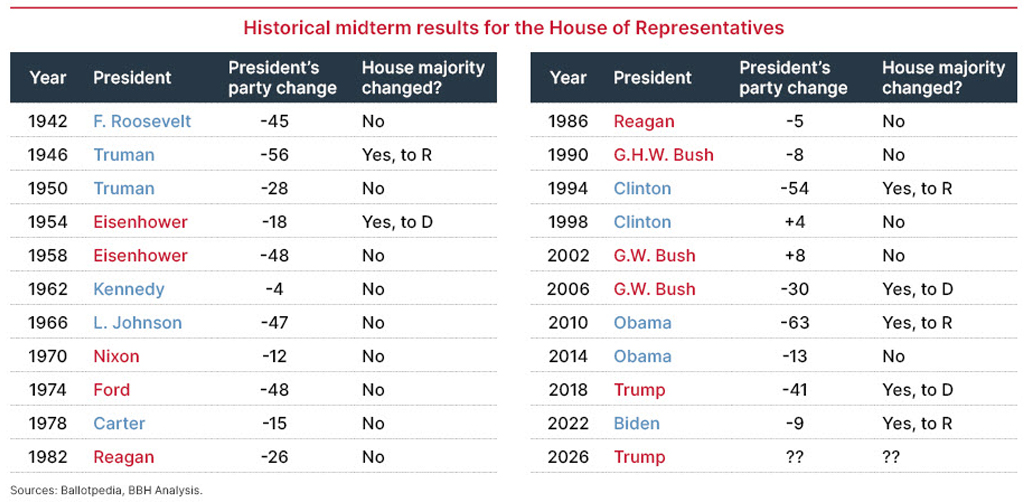
And yet this history does provide a slim hope for the Grand Old Party (GOP). The first exception to this 75-year rule occurred in 1998, when the notion of congressional overreach in Bill Clinton’s impeachment process resulted in the Democrats picking up four seats. Similarly (but to the advantage of the Republicans this time), the patriotic response to 9/11 and the onset of the war in Iraq gained George Bush’s Republican Party eight seats in the House in fall 2002.
Betting markets currently place odds of around 90% that history will indeed rhyme once again and that the Republican Party will lose its majority in the House.
The Senate
Unlike the House, only one-third of Senate seats are on the ballot (plus two special elections to fill the Senate seats vacated by Secretary of State Marco Rubio in Florida and Vice President J. D. Vance in Ohio). Earlier this year, betting markets gave the GOP as much as a 75% chance to hold onto control of the Senate. Those odds have now flipped to favor the Democrats by 62% as issues like affordability weigh on Republican candidates, and several seats initially deemed to be safe have turned into open races as incumbent GOP senators were primaried out of office.
The sheer numbers still favor Republicans. With a current majority of 53-47 in the Senate, and the ability of Vice President Vance to break a tie, Republicans can lose as many as three seats and still retain control. Democrats, on the other hand, have to pick up four seats to obtain a majority.
Toss-up Senate races | ||||
State | Incumbent | Poll Summary * | MOE ** | Implication |
Alaska | Sullivan | Peltola + 0.8 | 2.8-4.0 | DEM Gain |
Iowa | OPEN | Hinson + 0.6 | 2.8-3.3 | GOP Hold |
Maine | Collins | Jackson + 1.2 | 2.5-6.6 | DEM Gain |
Michigan | OPEN | El-Sayed + 2.5 | 2.5-4.4 | DEM Hold |
New Hampshire | OPEN | Pappas + 6.7 | 2.4-4.9 | DEM Hold |
Ohio | Husted | Brown + 3.3 | 2.0-4.5 | DEM Gain |
Texas | OPEN | Talarico + 1.8 | 2.2-4.9 | DEM Gain |
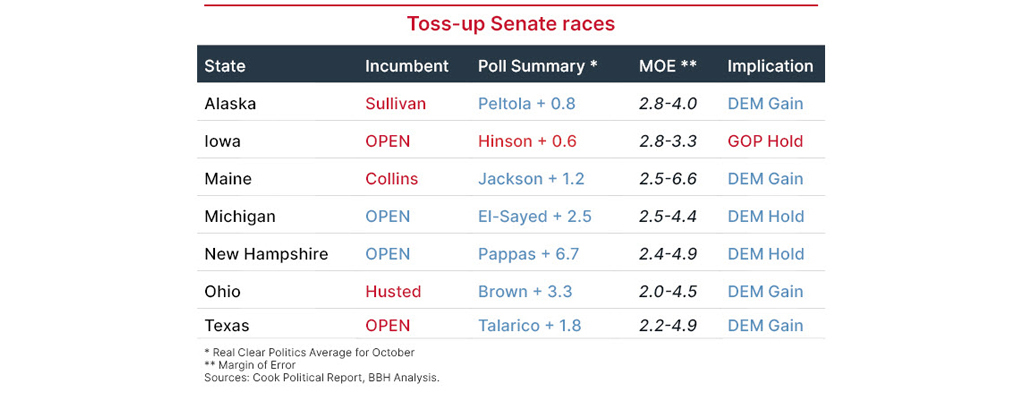
The Cook Political Report identifies seven races as true toss-ups, as shown in the nearby table. Readers are likely familiar with all of these races, regardless of residence, as they have all essentially become nationwide campaigns. Keeping in mind the earlier warnings about their diminished reliability, polls indicate that the Democrats do indeed have a better-than-even chance at flipping a few seats and taking over the Senate. Note, however, that in most of these races, the polls are well within the statistical margin of error.
What to watch
Both parties understand that turnout will be a decisive factor in this election. Turnout is typically lower in midterms, which is why President Trump has encouraged his base to “pretend that he is on the ballot.” Democrats, in a rare note of agreement with the White House, have adopted the same appeal, seeking to leverage the president’s poor approval ratings against Republican candidates.

Chart depicting consumer confidence by political affiliation according to the University of Michigan survey of consumer confidence, September 2006 to October 2026. The latest figures as of October 31, 2026, are 83.0 for Republican voters and 36.6 for Democratic voters.
We anticipate that turnout will favor Democrats. The University of Michigan survey of consumer confidence, broken down by party affiliation, shows that whereas Republicans remain more confident than Democrats, that confidence has waned over the past year. This won’t necessarily turn Republicans into Democratic voters, but it might depress enthusiasm and turnout on the Republican side.
The last few elections illustrate that outcomes are correlated, even across state lines. For example, Donald Trump rode into office in 2016 in no small part by sweeping the battleground states of Arizona, Georgia, Michigan, Pennsylvania, and Wisconsin. In 2020, however, all five of these states swung into the Joe Biden camp, lifting Biden to the White House. All five then reverted to Trump in 2024. These are genuine swing states (and remain so), but the swings are correlated. There is further evidence of this correlation in margins of victory in those states that reliably vote one way or the other. A reliably blue state in 2024 still voted for Kamala Harris, but with a narrower margin than it did for Biden in 2020.
This implies that early returns on election night might provide some indication of how the whole evening will unfold. Here are the bellwether races to watch hour by hour on election night.
Polls close in Georgia, South Carolina, Virginia, Vermont, and most of Florida. There are no seriously competitive races here, but margins of victory in Georgia, where Jon Ossoff (D) is running for re-election, and in South Carolina, where Darlene Graham (R) is running for a full term succeeding her brother Lindsey Graham (R), will provide an early look at the evening. In particular, if South Carolina is not called quickly, it bodes poorly for Republicans.
The race heats up. Roy Cooper (D) should win the Senate race in North Carolina, which would represent an expected flip in control of that seat. A Cooper loss seriously narrows the Democratic path to control. Ohio is a true toss-up: Sherrod Brown (D) has led in just about every poll, and the Democrats need this win (in a state that Trump won in 2024) to take the Senate. If his opponent Jon Husted (R) wins, the evening will go well for Republicans.
The biggest wave of poll closings. At this hour we should gain some insight into races in Maine, where Susan Collins (R) is trying to hold a Republican seat. The marquee events at this hour are Michigan, where Abdul El-Sayed (D) holds a slight edge in polls over his rival Mike Rogers (R), and Texas, which might elect its first Democratic senator (James Talarico, D) since Lloyd Bentsen (D) won a seat in 1988. Democratic victories here will seal the deal for Democratic control of the Senate. Some parts of Michigan and Texas are in an earlier time zone, which will likely make networks wary of making a premature victory call at this hour. New Hampshire should be a safe hold for Democratic candidate Chris Pappas (D), while a John Sununu (R) victory would represent a flip to Republican control.
The Midwest weighs in. Iowa, Nebraska, Minnesota, and the rest of Michigan, Kansas, and Texas close at this hour. Iowa is the race to watch here, as Ashley Hinson (R) and Josh Turek (D) vie for the seat from which Joni Ernst (R) is retiring. This is the sole swing race where a Republican has a slight edge in the polls ahead of Election Day.
There are no competitive races closing at this hour, but there might be some clearer insight into how earlier races are shaking out. Remember that the Democrats need to gain four seats to establish a majority. If Roy Cooper wins in North Carolina, as expected, the Democrats need to win three of the competitive races in Ohio, Maine, New Hampshire, Iowa, Michigan, and Texas to take the Senate.
In reality, narrow margins, absentee ballots, and delayed poll closings make it unlikely that these races will be quickly and decisively called, unless the margins are so robust one way or the other as to make the outcome obvious. Alaska (where polls don’t close until 1 A.M. Eastern Time) could be a curveball. If earlier races split, and if control of the Senate comes down to the Alaska race, and if no one wins an outright majority in Alaska’s ranked-choice voting, we will have to wait until as late as November 18 for this rather large state to count ballots. There are a lot of “ifs” in that last sentence, but stranger things have happened in elections.
Implications
Whether the Democrats succeed in gaining control of the Senate or not, the likely outcome is a divided government, in which a Republican president must deal with the opposition party in control of one, if not both, houses of Congress. What are the implications for legislation, the economy, and markets?
- As momentous as a change in political control is, the implications for government are ironically limited. The White House has not relied on a Republican majority in the 119th Congress to advance policy, preferring instead to use executive orders and courts to implement change. The notable exception is last year’s One Big Beautiful Bill Act (OBBBA), which, among other priorities, extended the 2017 Tax Cuts and Jobs Act. Even with a majority in the House, Democrats likely won’t have enough votes to override a presidential veto on legislation.
- One specific area of legislation to watch relates to artificial intelligence (AI). The White House is an advocate of AI in general, and data center development in particular, both of which have become points of friction on the campaign trail. Democrats have broadly supported limitations or outright bans on data center construction, and we anticipate that this will quickly become a point of legislative contention when the 120th Congress is seated on January 3, 2027. Capital investment in AI has become an important engine of economic growth, so any legislative constraints on this activity threaten to stall that engine. This is an area where governor races may have a bigger impact, at least on local economies, as states embrace or reject data center development to different degrees.
- Control of the House gives the majority party committee chairmanships and the ability to launch investigations. We anticipate that the Democrats will use these powers to launch investigations throughout the Trump administration, from cabinet officials all the way up to the White House itself. There are likely few economic implications here, although the already heated political environment is almost certain to intensify, with the risk of shorter-term uncertainty-fueled market volatility. A Democratic majority impeached President Trump twice during his first term and is likely to do so again. It requires only a simple majority to impeach.
- But it requires a two-thirds majority in the Senate to remove, and it is a far reach to imagine that around 15 Republican senators would join their Democratic colleagues in voting to remove President Trump from office. Only Mitt Romney (R) voted with Democrats to remove Trump following his first impeachment. He was joined by six more GOP senators following the second impeachment trial, but of those senators, only Lisa Murkowski (R) and Susan Collins (R) (if she holds her Maine seat) remain in office.
- Yet a simple Senate majority can block nominations, giving even a slight Democratic majority power over presidential appointments. At present, this is a moot issue: There are no vacancies on the Supreme Court, no vacancies in federal appeals courts, and no open cabinet positions. But there will be. It is quite common for cabinet officials to “retire early” during a president’s last two years in office, although “acting” secretaries can serve without Senate confirmation for up to 210 days (a rule honored more in the breach than in the observance).
- If there is a vacancy on the Supreme Court, we expect Democrats to invoke the “McConnell rule” used by then-majority leader Mitch McConnell to delay President Barack Obama’s nomination of Merrick Garland to the high court. McConnell argued that when different parties control Congress and the White House, the people ought to have the right to vote in the next election prior to the nomination of a justice. Such is likely to be the case following the midterms. Notably, there is no requirement or timeframe that the court have nine justices: There were only eight justices between the death of Antonin Scalia in February 2016 and Neil Gorsuch’s eventual appointment in April 2017. The court operates just fine with eight justices. A 4-4 tie in the Supreme Court means the decision of the lower court is automatically affirmed and left in place.
- A rare point of political agreement in Washington is that neither party cares about debt or deficits, except when politically expedient. Democratic policies tend to spend more money on entitlement and social issues, while Republicans tend to spend more money on military and tax cuts, but both lead to the same fiscal end of persistent deficits and rising debt. It would take rare bipartisan agreement to cut spending and/or raise taxes, and we don’t see that developing over the next two years.
- The debt ceiling could, however, put debt and deficits front and center for the new Congress. The ceiling was last raised in July 2025 (as part of the OBBBA), to the current level of $41.1 trillion, precisely to push the issue beyond the 2026 midterm election. Mission accomplished, but also mission postponed. Outstanding federal debt currently amounts to $40.2 trillion, allowing for the issuance of additional debt of $900 billion before bumping into legislative constraints. The federal deficit over the past year is just shy of $2 trillion, implying that the government has another six months or so before needing to raise the debt ceiling again. As has been the case in the past, we expect that this will become a political friction point again, as Democrats withhold votes in an effort to sway White House policy. It would not surprise us if a lame-duck Republican Congress voted pre-emptively to raise the debt ceiling to deprive a likely Democratic majority of this legislative weapon.
Asset allocation implications
Financial markets have typically looked through the uncertainty of changes in political control, and we expect this time to unfold similarly. It is important to remember that there are many more important drivers of markets than elections, including the underlying economy, company earnings, and valuations. There is certainly the possibility or even probability of short-term price volatility, but this is a feature, not a bug, of financial markets. Midterm election years have often seen volatility rise in October ahead of the election, yet once the election has passed, volatility has tended to subside.
Overall, divided government tends to be a positive backdrop for risk assets, as it decreases the likelihood of sweeping legislation that could have negative ramifications for markets. In our view, the election results are unlikely to warrant major changes to long-term investment allocations.
Yet the change in the balance of power in Washington could have implications for policy that can affect certain industries and sectors. One, which we alluded to earlier, is legislation that would encourage or restrain AI capital spending, and we are watching these developments closely, monitoring proposed policies that could affect AI investment fundamentals. Recommended portfolio changes would only follow evidence that policy is likely to alter business economics or expected returns, considered alongside valuation and the broader market backdrop.
A divided government leads us to expect no big changes one way or the other at the federal level. Still, state and local decisions on data centers, electricity, and taxes collectively have the potential to affect certain parts of the AI investment cycle even if Congress passes little. Governors, utility regulators, and local authorities influence where and when data centers can operate. Permitting delays, grid connections, water access, power charges, and changes to tax incentives can raise costs or postpone revenue. Texas is especially important because of its concentration of planned projects and ongoing review of large electricity loads. Georgia, Ohio, and other states also face debate over developments and their costs to communities. Changes in state rules or local exemptions would affect different projects and companies differently and therefore are best evaluated on a company-by-company basis.
Heightened political uncertainty reminds us of the importance of diversification. This is important in any economic, market, or political environment but is critically important at present given the wider range of potential outcomes. We encourage investors to revisit their asset allocation, as market appreciation and interest rate volatility might warrant rebalancing as the year comes to an end. Portfolios should remain aligned with each client’s objectives, liquidity needs, and capacity for risk.
Contact Us



References to specific securities, asset classes, and financial markets are for illustrative purposes only and are not intended to be and should not be interpreted as recommendations.
Investors should be able to withstand short-term fluctuations in the equity and fixed income markets in return for potentially higher returns over the long term. The value of portfolios changes every day and can be affected by changes in interest rates, general market conditions and other political, social and economic developments.
Investment Advisory Products and Services:
NOT FDIC INSURED NO BANK GUARANTEE MAY LOSE VALUE
Brown Brothers Harriman & Co. (“BBH”) may be used to reference the company as a whole and/or its various subsidiaries generally. This material and any products or services may be issued or provided in multiple jurisdictions by duly authorized and regulated subsidiaries. This material is for general information and reference purposes only and does not constitute legal, tax or investment advice and is not intended as an offer to sell, or a solicitation to buy securities, services or investment products. Any reference to tax matters is not intended to be used, and may not be used, for purposes of avoiding penalties under the U.S. Internal Revenue Code, or other applicable tax regimes, or for promotion, marketing or recommendation to third parties. All information has been obtained from sources believed to be reliable, but accuracy is not guaranteed, and reliance should not be placed on the information presented. This material may not be reproduced, copied or transmitted, or any of the content disclosed to third parties, without the permission of BBH. All trademarks and service marks included are the property of BBH or their respective owners. © Brown Brothers Harriman & Co. 2026. All rights reserved. PB-10002-2026-10-28