

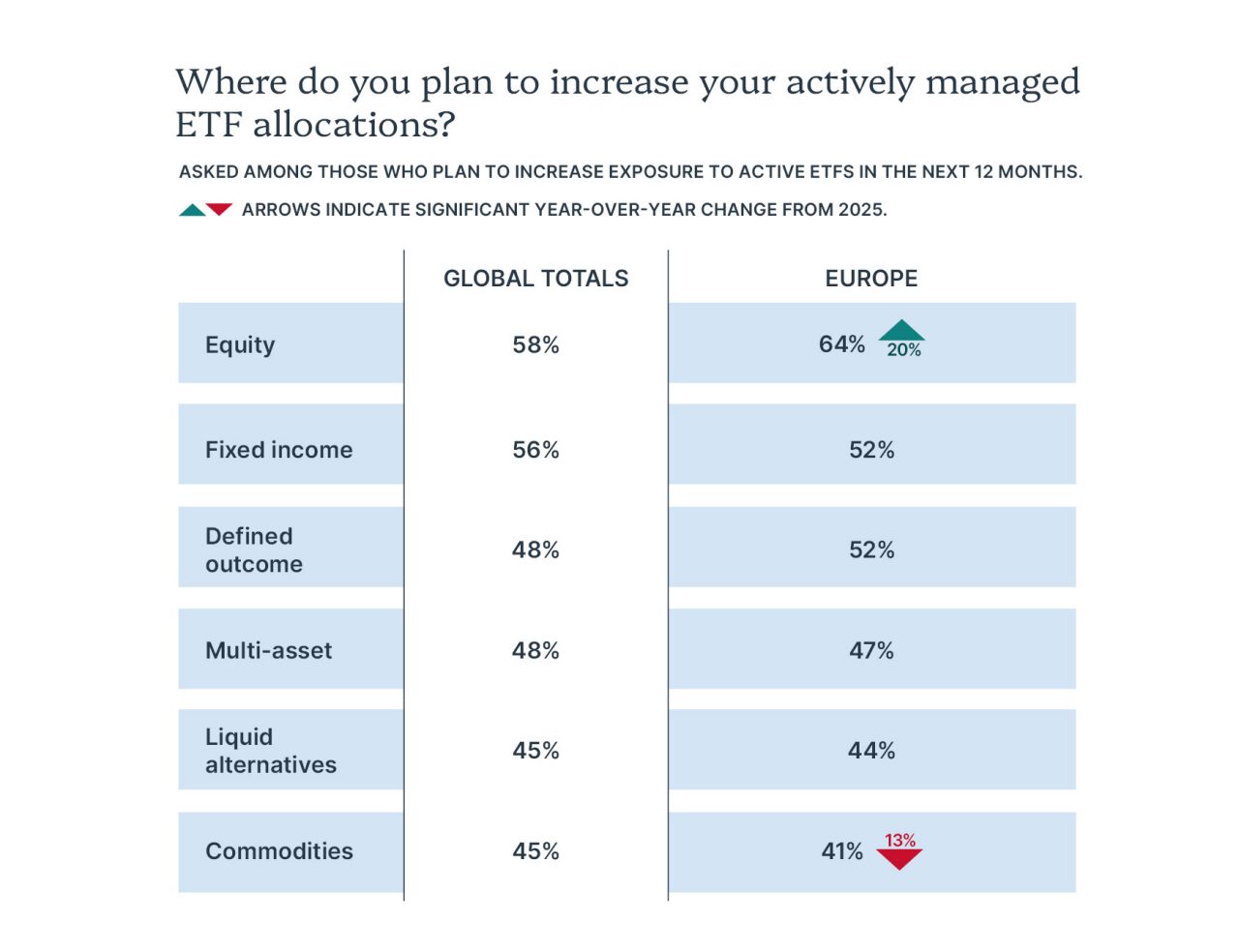
Table comparing Global and European investor plans to increase actively managed ETF allocations across six categories. Equity leads globally (58%) and in Europe (64%, up 20% year-over-year). Fixed income follows at 56% globally and 52% in Europe. Defined outcome and multi-asset each show 48% globally, with Europe at 52% and 47% respectively. Liquid alternatives (45% global, 44% Europe) and commodities (45% global, 41% Europe, down 13% year-over-year) round out the list.
The European ETF market continues to experience a steady stream of net inflows, an evolving landscape of products, and a growing investor base – all of which are attracting new entrants looking to expand their distribution footprint.
Compared to other regions where ETF adoption may be more mature, Europe has many unique facets which require attention, particularly when it comes to buyer preferences and behavior.
Because of this, we have highlighted some of the key themes in the region and European ETF buyer preferences based on our 2026 BBH Global ETF Investor Survey in this report.
Who we surveyed
European ETF investors from the following investor classifications:
- Institutuonal investor
- RIA/Financial advisor
- Fund management
- Private bank
- Wealth management
Standout stats
Today's European ETF landscape
Following the 25th anniversary of ETFs in Europe, their product range is still expanding and providing investors with greater choice. In the near-term, our survey indicates that investors plan to take a balanced approach to secure income while seeking protection against potential downside and volatility.
Nearly all European investors (94%) expect to increase their exposure to ETFs in the next 12 months. This is in line with overall market expectations as existing ETF issuers continue to see growing adoption of ETFs in their client portfolios. 34% plan to increase their exposure significantly (by 10% or more).
Points of interest
Where will future ETF growth be focused? Over the next 12 months, European investors plan to invest in dividend/income strategies (42%), a higher percentage than peers in the US (28%) and Greater China (27%). Sector or thematic equity exposure (29%), and multi-asset (26%) rounded out the top three areas of interest in Europe.
As caution remains top of mind, 18% said they also plan to purchase money market ETFs, which provide safety and liquidity with modest yields.
Active ETFs in Europe
Similar to global averages, 63% of European ETF investors prefer active management over passive in the next 12 months. In line with that sentiment, 98% plan to increase their exposure to active ETFs in the next 12 months.
Where will allocations to active ETFs be focused? When asked to list their top three targets:
- 64% ranked equity
- 52% noted fixed income
- 52% listed defined outcome
Rising stars: ETFs in Germany
Few European countries have embraced ETFs as enthusiastically as Germany. A twin catalyst of Covid pandemic lockdowns and negative interest rates in the early 2020s helped persuade a growing number of tech savvy German savers to switch from low yielding bank accounts to a new breed of ETF based savings accounts or “sparplans.” Germany saw 14.5 million ETF holders generating €20.5bn of ETF inflows during the first quarter of 2025 alone, much of which was retail business[1]. Just 25 years after the first ETF was launched in Europe, a quarter of all retail fund assets held by German investors are now in ETFs, with more growth forecasted[2].
Map for issuers
What are investors looking for in an ETF?
- 20% of European investors ranked strategy or sector focus as the top consideration this year, with a six-point increase bumping it from being the second most favored in 2025.
- 17% noted liquidity and trading costs as their top selling point.
- 14% of investors find brand reputation following as the most important factor. Fund size and historical performance were the least important criteria when considering an ETF.
Expectations for ETF managers go beyond providing a quality product, with additional services offering an opportunity for differentiation. Investors believe that ETF issuers can add the most value through client service and ETF support services such as execution and portfolio consulting (66%), offering innovative or niche investment strategies (61%) and providing insightful market research and analysis (60%).
The parity among responses shows that investors look at these factors nearly equally, reinforcing the importance of a well-rounded value proposition for sponsors.
Also on a competitive note, investors are looking to expand the ETF brands that they work with, which represents a window of opportunity for issuers. Over the next 12 months, 64% of European investors expect the number of ETF issuers that they are investing with to increase.
Share class signals
Most of our European respondents (82%) would invest in an ETF share class of a mutual fund, compared to 86% in the US market.
These hybrid models, which can make unlisted and listed share classes available in the same fund, are attracting a lot of interest globally as an entry point for ETF launches.
ETF share classes have been available in Europe for over a decade with more recent changes in Ireland to the naming convention which has opened up the way for unlisted share classes on ETFs.
The path forward for ETFs in Europe
The path forward for ETFs is not without hurdles. Only 6% of European-based professional ETF investors we surveyed did not experience an issue when increasing their ETF exposure.
This means a stark 94% perceived issues when trading ETFs, with over 50% citing sparse ETF availability on platforms and lack of educational resources. While this seems to paint a somewhat bleak picture, the reality is that the European ETF industry is in the midst of a significant shift that presents growth and opportunity.
What is driving this? One theme dominating the conversation is the rapidly emerging retail segment in what has historically been a heavily intermediated market.
A learning process
A key obstacle highlighted by respondents to our survey as a barrier to additional ETF investment is knowledge. 26% of respondents reported that the largest issue they face to buying more ETFs is a lack of research tools and education on ETFs. Although some ETF providers are working hard to explain their key strengths to a wide audience, it’s challenging. While Europeans tend to be good savers, many do not have the knowledge to invest with confidence at a retail level, either in ETFs or even the simplest products. According to the European Commission, around €10 trillion in savings from EU citizens are sitting in banks.
There are approximately 383 million potential retail investors in Europe and only 32.8 million3 investing in ETFs.
When you combine that with European SIU incentive programs, the anticipated transfer of generational wealth, and increase of Gen Y and Z investors trading ETFs via so-called neobrokers and online apps, Europe – and especially ETF issuers – appear well poised for this expected growth wave.
Why the SIU matters
Europe hopes to leverage its vast pools of capital to better support its wider economic needs. The Savings and Investment Union (SIU) seeks to transform European citizens from savers to market investors by encouraging them to move money out of their banking and savings accounts into investments such as ETFs. It could help fund the economy while also providing financial benefits for citizens.
Still, some may be prevented from buying more ETFs, with 24% noting that certain ETFs don’t meet their minimum threshold for assets under management, while 22% note limited availability of ETFs on their investment platform.
Conclusion
Rising geopolitical tensions and uncertainty over the direction of stocks and interest rates have European investors clamoring for flexibility in investments.
At the same time, changing regulations and moves by policymakers to improve financial literacy could encourage more European savers to invest while unlocking new European capital flows into investment fund structures such as ETFs.
As these paths intersect, the flexibility of ETFs will allow them to adapt to market conditions and investor demand. We look forward to charting these new opportunities with the industry.
For over 20 years, BBH has served as a leading provider of ETF services to both established global asset managers and those entering the ETF market across Europe, the United States, and Asia. Through the integration of leading-edge technology and outstanding client service, we deliver tailored solutions that empower our clients to achieve operational excellence and long-term success in the evolving ETF landscape.
1EY. European ETF market surges 41% to over €2.7 trillion in 2025, on track to
hit over €5 trillion by 2030. 27 February 2026.
2BVI Research. New data on ETFs held in Germany. 16 October 2025
3 https://www.blackrock.com/uk/literature/brochure/people-and-money-etf-europe.pdf
Brown Brothers Harriman & Co. (“BBH”) may be used to reference the company as a whole and/or its various subsidiaries generally. This material and any products or services may be issued or provided in multiple jurisdictions by duly authorized and regulated subsidiaries. This material is for general information and reference purposes only and does not constitute legal, tax or investment advice and is not intended as an offer to sell, or a solicitation to buy securities, services or investment products. Any reference to tax matters is not intended to be used, and may not be used, for purposes of avoiding penalties under the U.S. Internal Revenue Code, or other applicable tax regimes, or for promotion, marketing or recommendation to third parties. All information has been obtained from sources believed to be reliable, but accuracy is not guaranteed, and reliance should not be placed on the information presented. This material may not be reproduced, copied or transmitted, or any of the content disclosed to third parties, without the permission of BBH. All trademarks and service marks included are the property of BBH or their respective owners. © Brown Brothers Harriman & Co. 2026. All rights reserved. IS-11486-2026-04-24