IEEPA tariff refunds: Five key questions answered

June 23, 2026
  • Capital Partners
The largest tariff refund in U.S. history is underway. Corporate Advisory & Banking Analysts Alexa Arana, Sally Anne Houck, and Alex Konovalov explain who qualifies, how refunds work, and what’s at stake.

It’s the old proverb, “What you give is what you get.” Here, more precisely, what you get is exactly what you gave. As International Emergency Economic Powers Act (IEEPA) tariff refunds begin flowing back to importers, understanding how to claim them is essential.

The U.S. Supreme Court’s decision to strike down IEEPA tariffs has set in motion the largest tariff refund in U.S. history. Funds are now being returned, but the more important question is how to claim them before eligibility windows begin to close.

IEEPA tariffs by the numbers*

  • $166 billion

    in tariffs paid by

  • 330,000+

    importers on

  • 53 million

    shipments

*As of publication.

What are the different tariff authorities?

Understanding how these refunds work starts with the legal distinction that made them possible. Tariffs flow from several statutory authorities, each with its own predicate, process, and legal footing. The five main authorities – Section 232, Section 301, antidumping (AD)/countervailing (CVD) duties, Section 122, and IEEPA – differ in their legal triggers, their durability, and critically, whether the duties they produced can be recovered.

For refund purposes, the distinction is straightforward: Only IEEPA tariffs are currently eligible for recovery.

  • Section 232 (Trade Expansion Act of 1962) is the most established form of taxation, authorizing the U.S. president to restrict imports that threaten national security, but only after a formal Commerce Department investigation. This process produced the 25% tariffs on steel, aluminum, copper, and automobiles, providing them with a durable legal foundation.
  • Section 301 (Trade Act of 1974) highlights unfair foreign trade practices and over the past decade has heavily targeted China, with tariffs on over $360 billion worth of Chinese goods following formal investigations from the U.S. Trade Representative. More recent Section 301 investigations into foreign industrial overcapacity are expected to generate new tariffs in the coming months, and the Trump administration plans to pivot to Section 301 as its durable replacement authority once the Section 122 surcharge expires in July (see IEEPA bullet below for more detail).
  • AD/CVD duties apply to foreign goods sold below fair value or propped up by government subsidies. They are product- and country-specific and decided through formal International Trade Commission proceedings.
  • Section 122 (Trade Act of 1974) authorizes the president to impose a temporary surcharge – up to 15% for no more than 150 days – to address “balance-of-payments deficits,” a term the statute ties to specific 1970s-era economic metrics rooted in the Bretton Woods system, several of which the government no longer publishes.
  • IEEPA is the source of the entire refund opportunity. Congress passed IEEPA in 1977 to give the president fast-acting tools against unusual foreign threats: asset freezes, sanctions, and financial pressure. In nearly 50 years, no president had used it to levy tariffs; however, in early 2025, President Trump invoked IEEPA to tax goods from nearly every U.S. trading partner at once. IEEPA demands no investigation, review period, or act of Congress; a declared national emergency is (or at least was) sufficient. That speed was the point, and as the courts would later find, the problem.

When did all of this happen?

That distinction set the stage for how quickly – and how broadly – the tariffs expanded. The tariffs that reshaped global trade in 2025 and 2026 did not land all at once – they compounded rapidly, in ways most supply chains were not built to absorb.

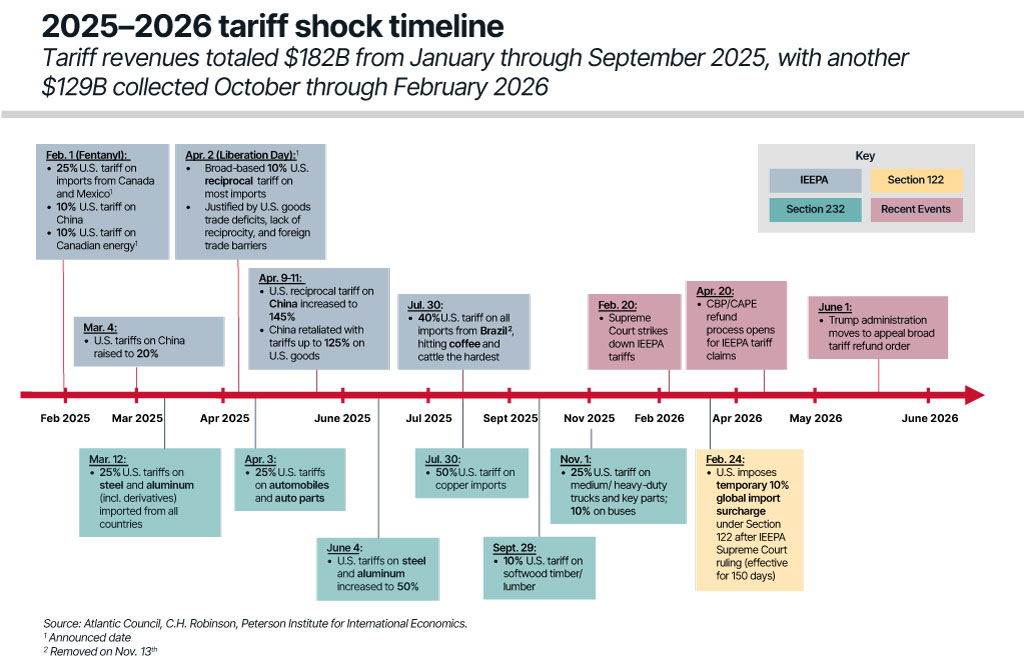
On February 1, 2025, the administration imposed 25% tariffs on Canada and Mexico and 10% on China under the IEEPA, citing fentanyl trafficking. Within two months, the scope expanded from three countries to nearly the full breadth of global commerce.


2025 – 2026 tariff shock timeline

Tariff revenues totaled $182B from January through September 2025, with another $129B collected October through February 2026. Timeline from February 2025 (left) to June 2026 (right):

Feb. 1 (Fentanyl):

• 25% U.S. tariff on imports from Canada and Mexico1

• 10% U.S. tariff on China

• 10% U.S. tariff on Canadian energy2

Mar. 4:

• U.S. tariffs on China raised to 20%

Mar. 12:

• 25% U.S. tariffs on steel and aluminum (incl. derivatives) imported from all countries

Apr. 2 (Liberation Day):1

• Broad-based 10% U.S. reciprocal tariff on most imports

• Justified by U.S. goods trade deficits, lack of reciprocity, and foreign trade barriers

Apr. 3:

• 25% U.S. tariffs on automobiles and auto parts

Apr. 9-11:

U.S. reciprocal tariff on China increased to 145%

China retaliated with tariffs up to 125% on U.S. goods

Jun. 4:

U.S. tariffs on steel and aluminum increased to 50%

Jul. 30:

• 40% U.S. tariff on all imports from Brazil2, hitting coffee and cattle the hardest Jul. 30:

• 50% U.S. tariff on copper imports

Sept. 29:

• 10% U.S. tariff on softwood timber/ lumber

Nov 1:

• 25% U.S. tariff on medium/ heavy-duty trucks and key parts; 10% on buses

Feb. 20:

Supreme Court strikes down IEEPA tariffs

Feb. 24:

U.S. imposes temporary 10% global import surcharge under Section 122 after IEEPA Supreme Court ruling (effective for 150 days)

Apr. 20:

CBP/CAPE refund process opens for IEEPA tariff claims

June 1:

• Trump administration moves to appeal broad tariff refund order

Source: Atlantic Council, C.H. Robinson, Peterson Institute for International Economics.

1 Announced Date

2 Removed on Nov. 13th

On April 2, 2025 – nationally dubbed as “Liberation Day” – the rationale shifted from a narcotics emergency to a sweeping theory of reciprocal trade fairness. A 10% baseline tariff was enacted on most imports, with steeper country-specific rates stacked on top. That pivot, from targeted pressure on three countries to a blunt instrument applied across the entire trading system, would later anchor the legal challenge.

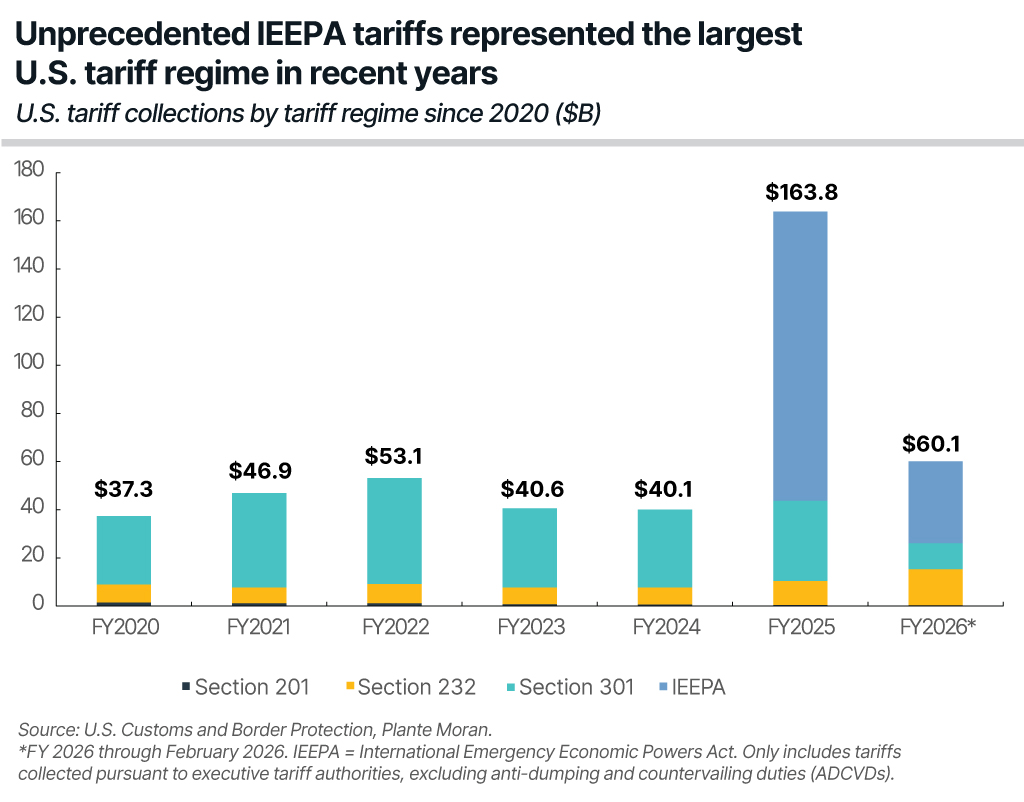
In total, tariff revenues reached $182 billion from January through September 2025, with another $129 billion collected from October through February 2026. Of that $311 billion, more than 330,000 importers paid a combined $166 billion under IEEPA across over 53 million shipments.


Chart depicting U.S. tariff collections by tariff regime since 2020 in billions. The IEEPA tariffs were the largest U.S. tariff regime in recent years, collecting $163.8 billion in fiscal year 2025 and $60.1 billion in fiscal year 2026 (through February).

The impact on individual importers was anything but theoretical. A single business bringing in containers of Chinese goods could experience a six- or seven-figure annual tariff-related bill that was unfathomable a year earlier – charges paid at the border, in cash, long before they could ever be passed on to a customer.


Chart depicting the cumulative price change in select commodity and equity benchmarks – gold ($/troy oz.), steel HRC ($/ton), the S&P 500, and coffee C futures – since January 2025. As of April 27, 2026, the latest figures are $4,708/troy oz., $1,042/ton, $7,165, and 295¢/lb., respectively.

Gold’s climb past $4,700 per troy ounce was less a response to any single announcement than a standing bet on how long the disruption and uncertainty would last. Steel and coffee, on the other hand, told a more direct story: Tariffs repriced inputs faster than contracts could be renegotiated, squeezing margins in real time. Coffee later fell after it was exempted from the Brazil tariffs in November 2025, which is why the chart shows a reversal after the initial spike.

Legal challenges followed the market mayhem. The core argument was straightforward: IEEPA was not a tariff statute, and the Constitution hands the power to tax and impose duties to Congress, not the president. The same speed and breadth that made the IEEPA tariffs so sweeping (that is, no investigation, comment period, or congressional vote required) is what made them constitutionally vulnerable.

On February 20, 2026, the Supreme Court agreed. In Learning Resources Inc. v. Trump, the Court ruled 6-3 that IEEPA does not authorize tariffs. The Trump administration quickly pivoted to Section 122, imposing a 10% surcharge effective February 24. However, Section 122 came with constraints the IEEPA tariffs never had: a 15% rate cap, a 150-day clock, and a statutory trigger tied to “balance-of-payments deficits.” During an oral argument on April 10, the government conceded as much, acknowledging that Congress’ policies forming the original statute “are no longer considered relevant.”

On May 7, a divided Court of International Trade (CIT) panel ruled the surcharge unlawful, finding that the proclamation cited trade deficits and current-account shortfalls – not the specific balance-of-payments metrics the statute requires. The injunction, however, was narrow, and it applied only to three named plaintiffs (the State of Washington, Burlap and Barrel, and Basic Fun), leaving every other importer still obligated to pay. On May 12, the Federal Circuit issued an administrative stay, suspending even that limited relief. Eight days later, the CIT denied the government’s separate motion for a stay pending appeal, with even the dissenting judge concurring that the balance of harms favored the importers. The DOJ expects “hundreds, if not thousands” of additional challenges.

In the background, the administration is building its next line of defense: two Section 301 investigations spanning 76 separate tariff determinations, expected to conclude before the Section 122 surcharge expires on July 24, 2026. Unlike IEEPA or Section 122, Section 301 tariffs carry no expiration date. If they materialize at the scale the administration intends, they could approximate the breadth of the original IEEPA tariffs, and on far more durable legal ground.

Against this backdrop, the critical question for companies becomes straightforward: are they eligible to recover what they paid?

Who is eligible for refunds?

Eligibility is more limited than many expect.

Refunds began within two months of the February ruling. On April 20, 2026, U.S. Customs and Border Protection (CBP) launched Phase 1 of the Consolidated Administration and Processing of Entries (CAPE) system to process refunds. Initial payments began arriving as early as May 12.

To qualify, importers must meet three core criteria:

  • Confirm IEEPA applicability. Only duties imposed under IEEPA reciprocal tariffs, including the 10% baseline rate, fentanyl-related tariffs, and country-specific emergency tariffs that fall under the IEEPA umbrella, from February 1, 2025, through February 23, 2026, are eligible. Tariffs under Section 232, Section 301, or AD/CVD are not refundable.
  • Meet the liquidation window. Eligibility depends on whether entries are liquidated or unliquidated. A liquidated entry is an import entry where CBP has completed its review and finalized the duties, taxes, and fees owed. By contrast, an unliquidated entry is still open in CBP’s system, meaning duties can be corrected or adjusted before finalization. Phase 1 focuses on simpler cases and only covers two categories of entries:
    • Entries that have not yet been liquidated
    • Entries that were liquidated within the past 80 days under CBP’s voluntary liquidation window

    The 80-day window is not a one-time deadline; it is a per-entry rolling clock tied to the liquidation date of each shipment. Each entry has a liquidation date – the date CBP finalizes the duties owed on that specific shipment – and the refund deadline ticks from that date.

    Entries from early in the tariff period are already expiring, so it is essential to be aware of each shipment’s timeline. Once a window closes on an entry, eligibility is permanently lost. IEEPA-affected entries outside of the 80-day post-liquidation window will not be eligible for refunds until Phase 2 launches. Phase 2, said to begin late June 2026, aims to refund reconciliation entries, where the IEEPA duty is allocated across different entry dates or periods and must be reconciled by CBP. Phase 3, anticipated to follow one month later, will cover entries that have been fully liquidated and are at least 180 days past the date of liquidation.

    Phase 1 is expected to cover approximately 63% of affected entries, representing nearly $127 billion of the $166 billion total.

  • Confirm the legal claimant. Refunds are only issued to the Importer of Record (IOR) or a designated notify party, as identified on CBP Form 4811. The IOR is defined as the person or entity that owns or purchased the goods, or a licensed customs broker acting on their behalf. While the IOR is the legal claimant for the refund, they may also designate a notify party – such as a parent company, subsidiary, or accounting entity – to receive the funds on their behalf. Consignees, foreign suppliers, or other parties who paid the tariff indirectly are not eligible.

More recently, on June 2, 2026, the government appealed the refund order to the Federal Circuit. The appeal does not contest refunds on entries that remain unliquidated or fall within CBP’s 80-day voluntary reliquidation window; instead, it contests the government’s obligation to refund “finally liquidated” entries – older entries past that window – for importers that never filed suit at the CIT. The practical effect is a refund universe split in two: The roughly 4,000 businesses that filed at the CIT remain positioned to recover across all categories, while those that did not may find the most-aged portion of their claims contested. As of now, no stay has been granted, and CAPE continues to operate as described.

For those that qualify, the next step is navigating how to actually claim the refund.

Phase 1 is expected to cover approximately 63% of affected entries, representing nearly $127 billion of the $166 billion total.”


Where do companies apply?

Refunds are not automatic. Eligible importers must actively file through CBP’s Automated Commercial Environment (ACE) Secure Data Portal. The ACE Portal serves as a centralized access point connecting CBP, the trade community, and U.S. partner government agencies involved in international trade. The following outlines CBP’s refund process and the steps required to submit a claim correctly.

CBP refund process

  • Submission: Only the IOR or a licensed customs broker who filed the original entry may submit a refund request. A valid ACH banking account must be added to the ACE Portal in advance. Third-party trade consultants cannot file on behalf of an importer unless they have a formal brokerage relationship in place.
  • Calculation: CAPE cross-references submitted entries against CBP records and recalculates duties as if IEEPA tariffs had never been applied. Refunds reflect the difference between amounts paid and adjusted duties, plus statutory interest accrued under 19 USC 1505(c) from the date of deposit through the date of refund.
  • Validation: CBP verifies calculated refund amounts. Entries flagged for discrepancies may be denied for failing entry-specific validations. However, importers whose claims are denied can take steps to correct missing or incorrect information and restore the refund.
  • Disbursement: Approved refunds are sent to IORs as lump-sum ACH payments.

As of May 2026, approximately $85 billion in claims have entered processing, with $20.6 billion in final disbursement. The nearby chart shows the nearly 16 million entries with IEEPA duties that have been accepted – and in most cases, refunded – in the first phase of the refund process. CBP has indicated that processing typically takes 60 to 90 days, depending on submission accuracy.


Chart depicting the status and number of IEEPA entries: approved, refunds received or en route; entries validated, refunds not yet approved; Phase 1 entries rejected or not yet filed; and entries not eligible under Phase 1. As of May 22, 2026, the latest figures are 8.52 million, 7.34 million, 17.65 million, and 19.67 million, respectively.

Source: Data as of May 22, 2026, compiled by Bloomberg from Customs and Border Protection court filings

Why does this matter, and how does it affect me?

Once refunds are secured, the focus shifts from process to impact. For eligible importers, tariff refunds represent a near-term liquidity event, returning cash paid upfront at the border, often months earlier. But refunds are a one-time reversal, not a structural reset. Section 232 tariffs and other trade measures remain in place, meaning underlying cost structures across commodity-linked industries have not normalized.

The more consequential question is who ultimately bears the economic burden.

  • If companies absorbed tariffs, refunds improve margins and liquidity.
  • If costs were passed through, the benefit may instead belong to customers, creating commercial and reputational trade-offs around pricing and repayment.

The ability to redistribute refunds back to customers who originally incurred the costs has yet to be determined, as the process is still unfolding, and most importers are still awaiting their refunds.

Accounting treatment adds further complexity. Refunds may be recorded as a reduction in cost of goods sold or as a one-time gain, materially affecting how financial performance is interpreted. For lenders and investors, normalizing these effects is essential to understanding underlying earnings power.

Refunds force a repricing decision: retain margin expansion or pass savings through to preserve customer relationships in an environment where tariff-related costs have not fully disappeared.

While IEEPA tariffs continue to be unwound, the larger trade environment remains unsettled. The administration is already pivoting toward more durable tariff frameworks – particularly Section 301 – which could reintroduce similar cost pressures on firmer legal footing. For companies with U.S. import exposure, the immediate task is capturing available refunds. The longer-term challenge is navigating a trade landscape that is structurally more complex – and more uncertain – than it was just two years ago.

For more information on IEEPA tariff refunds and how they may affect you, reach out to your BBH relationship team.

Contact Us

Up Next
Up Next

The power of U.S. private businesses: Pivotal moments over 250 years

Private businesses have been a cornerstone of the U.S. across its 250-year history. Here, we take a closer look at private businesses’ and their owners’ significant contributions to the U.S. economy, historical milestones, and heritage.

Brown Brothers Harriman & Co. (“BBH”) may be used to reference the company as a whole and/or its various subsidiaries generally. This material and any products or services may be issued or provided in multiple jurisdictions by duly authorized and regulated subsidiaries. This material is for general information and reference purposes only and does not constitute legal, tax or investment advice and is not intended as an offer to sell, or a solicitation to buy securities, services or investment products. Any reference to tax matters is not intended to be used, and may not be used, for purposes of avoiding penalties under the U.S. Internal Revenue Code, or other applicable tax regimes, or for promotion, marketing or recommendation to third parties. All information has been obtained from sources believed to be reliable, but accuracy is not guaranteed, and reliance should not be placed on the information presented. This material may not be reproduced, copied or transmitted, or any of the content disclosed to third parties, without the permission of BBH. All trademarks and service marks included are the property of BBH or their respective owners. © Brown Brothers Harriman & Co. 2026. All rights reserved. PB-09660-2026-06-04

As of June 15, 2022 Internet Explorer 11 is not supported by BBH.com.